Arctic Yule
a seasonal short story by Stephanie Bretherton


There is ice on his eyelashes. He should be wearing his goggles, but they keep fogging up. The gears are stuck, but it makes no sense. The monster machine was given a full maintenance check only yesterday.
He can see nothing wrong. He can see pretty much nothing at all, but that is not unusual here, in the winter dark. He climbs back up into the cab, glad of its warmth, glad of the wrapping of tinsel around the dash, glad of something that speaks of the possibility of love. He will have to sit and wait for the mechanics.
Stupid time of year to be trying to dig up more ice cores, they need every floodlight set up, but the surveyors seem to be onto something. And the pay is too good to turn down, especially with Christmas around the corner. There are consolations. The Aurora Borealis fights with nothing out here. It has a pure, blank canvas. No light pollution, no need to view it through a camera to feel its awe. Something, at least, is at home here.
The lights, yes, but also the bears. The seals beneath the shrinking sea ice. The indigenous people who have more sense than to hunt for something that will give them the knowledge that is already in their bones. Oh yes, they know things. Things that the rest of us should know and things most of us would not want to know.
Another consolation is the coffee in his thermos. Only instant swill, but it’s strong and it’s warm and it works. He thinks of that quirky “folk” café in Oslo where he first summoned up the courage to speak to her. Famous for its spiced lattes. She drank hot chocolate with marshmallows instead and smiled at him through a moustache of cream. He aches for her.
He should not, but he pulls out the hip flask from the depths of his padded pocket and adds a dash of Cognac to the red plastic cup. His father‘s favourite drink, perhaps not the most macho or patriotic of tipples but it has become his, like so many of his father’s attributes. All but one, the one he has fought so hard to suppress, the one that had seen him and his mother pack up and run as far north as they could go. Away from a sordid scene of desolation on a Scottish island to a forestry camp in the Arctic Circle, where she had a brother. Where they had a chance.
As soon as he was old enough, he had sought the distractions of the city, learned to operate a crane in the construction industry, taken the required break to do his military service, then enjoyed the pay packets and the freedom from society (and its too many questions) on the North Sea oil rigs.
He had been back to his father’s island only once. And not by choice. The brute had finally drunk himself to death and there were loose ends to tie up. He wanted nothing. There was not much to have, so he left with only closure.
He had considered going south from there, seeing where else he could earn a good living. Seeing what a palm tree looked like. Nevertheless, he keeps gravitating to Oslo. And upwards. As much as sometimes he hates it, the north clutches on to a piece of his soul. It wants something from him.

The mechanics depart as annoyed as when they arrived. They were supposed to be enjoying a day off in the frayed and fuggy comfort of the insulated cabins back at base. Finishing their game of poker. One of them frets about missing his flight back home for the holidays. But at least they have solved the problem, simple as it was, and one that, apparently, he could have fixed himself with instruction over the radio. That was not his job. He isn’t insured to go anywhere near the inner machinery. This piece of equipment costs more than he could make in a lifetime.
But now he’s able to manoeuvre it to the spot the surveyors have marked out, and to slowly lower the drill. The scientists have emerged from their heated tent and are ready to extract the ice core once it rises.
He knows one of them by name, a cheerful but quiet chap called Ricardo. One of the few who had introduced himself when he’d first arrived here and had shaken his hand. Someone in whom he senses a genuine kindness but about whose life he knows nothing at all. It is often better that way in this kind of work.
The drill slices down. As it does, he thinks he sees something moving in the dim distance. If it’s a bear, he should sound the alarm, and the scientists need to clamber up into the cab with him. He will need to ready the rifle.
But it’s gone again, whatever it was, leaving only a shiver under his skin. A shiver that will not quit and which becomes a dark cloud over his heart that he cannot shake. He has the unspeakable feeling that he must not bring up this ice core. He thinks he hears the Sami grandmother of his beloved telling him to stop. To turn around and drive away. But, of course, he can’t.
He touches the tinsel that Birgit had hidden in his backpack, to give him a smile when he pulled out a fresh pair of socks. To get him into the Christmas spirit and remind him of everything that was waiting for him at home.
He touches it for luck. He doesn’t know whose luck it should be, but he wants to say a prayer for the first time since he was six. He cannot think of any, so he searches his memory for a Christmas carol. He comes to one he knows in three languages and begins to sing. It soothes him. He had forgotten that he used to sing, and — so everyone had said — very well. He lets out his voice in ever greater volume to chase away the shiver and illuminate the shadow. Silent Night. Stille Nacht. Glade Jul…
***
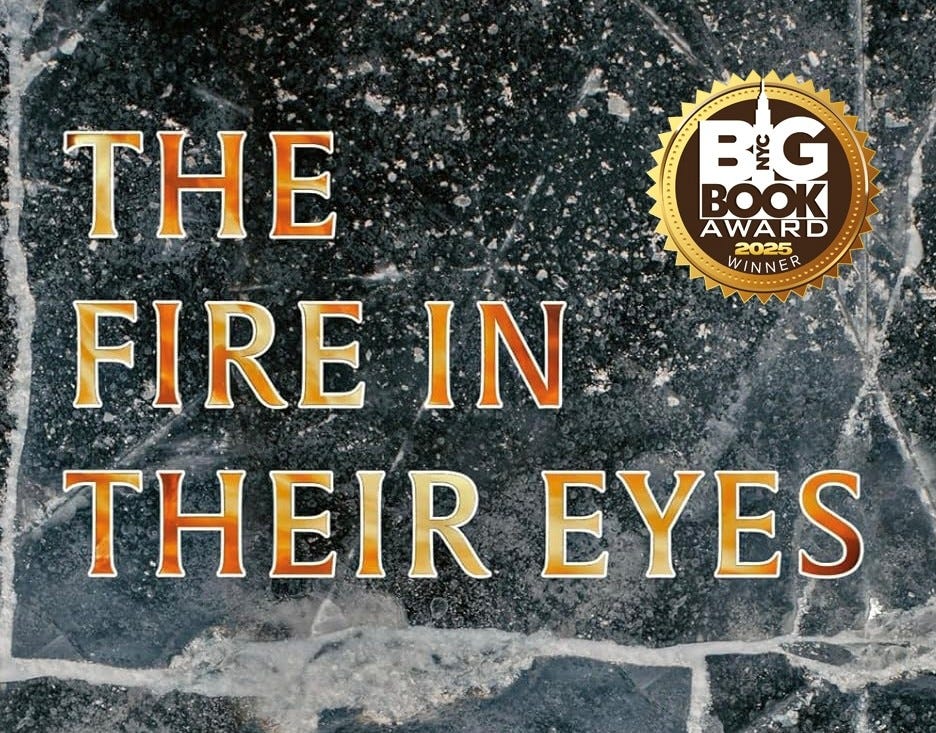
(This original story, copyright of Stephanie Bretherton, is inspired by her Children of Sarah novels, and might be considered a prelude to The Fire In Their Eyes, the award-winning, second, stand-alone book in the series, published by Breakthrough Books in June 2025.)